Showing posts with label Arthritis Research Centre. Show all posts

Friday, 28 November 2014

Changing Shoes: The Impact of Arthritis on Self Identity and Roles

Dr. Catharine Backman is a Professor and Head of Department of Occupational Science and Occupational Therapy at the University of British Columbia and a research scientist at the Arthritis Research Centre. She got the biggest response on the #eROAR twitter stream talking about her research on ways arthritis can change your self-identity.

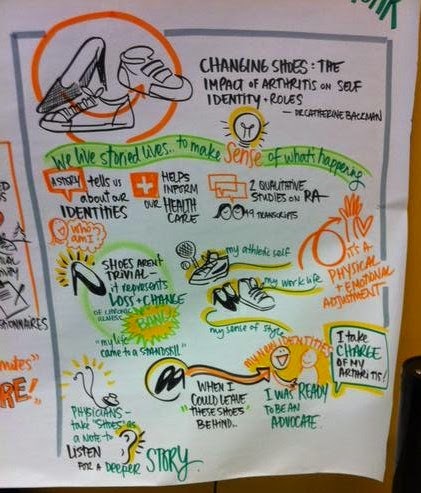
Sam Bradd's graphic depiction of Dr. Backman's talk

Dr. Backman has done two studies about self identity and role changes, and said the most powerful example of the loss of self was the shoe metaphor. "We lead storied lives and the narratives and metaphors we use help us and others to make sense of our experiences."

"Changing shoes" represents not only a physical adjustment to accommodate pain, but also part of an internal process of reshaping identity. It is a very constant symbol of loss of professional self, stylish self, working self. Women eventually "gave up" their shoes and found a new sense of self or an identity no longer represented by the old shoes"

One of the contributors said that if you were more sedate and always wore granny shoes this issue may not turn your life around, but I don't know anyone under 50 who feels like that. When I went to a shoe store looking for style and comfort at the onset of arthritis, and they showed me the granny shoes I almost walked out (almost cried is actually more accurate). I ended up with green leather lace up boots and that helped.


These shoes are not cool. Will never buy shoes like these

Part of your life is gone, it's an internal process of reshaping identity symbolized by shoes.

.@cath_back at : how can the experience of living with change how people view themselves?

Important to share stories of how people came to transition to new identity with  @arthritis_UBC

"Flat shoes meant pants and never wearing dresses...my life became different...after a few years RA just wasn't getting better"

Experiencing - a transition story: Giving up steel-toed boots = giving up the job. Flat shoes = never wearing dresses   ARC

Very true! @anetto: Shoes is a transition story, and it's not a transition people want.

For women: the type of shoe worn mirrors the life being lived> high powered work/ special occasions all accompanied by elegant shoes.

Metaphor of changing shoes represents many losses occurring as part of living with  

@Arthritis_UBC @Bonnycastle @nxtstop1 @cath_back Finding like minded people a big help. They're in mourning too for cool shoes

Past blog post of my own about shoes and life changes  http://yourgoldwatch.blogspot.ca/2013/01/cry-me-river-of-shoes.html 

@Bonnycastle @nxtstop1 huge adjustments to 'who I am' - @cath_back suggests finding like-minded people via online groups/blogs could help

You all just gave me my next blog post idea. I have so many pretty shoes mourning in my closet! Along with outfits. My closet cries! @RareCandace

@Bonnycastle @Arthritis_UBC  Oh how wonderful ~ life : turning lemons into lemonade

MT @sarahlance: @nxtstop1 @maryadevera I have arthritis & plan 2 hike again. worry re perception we get as person w/RA,stereotyped...

Reading your stories makes me glad I can still look like I'm in college, so flip flops, flats, boat shoes. I'm very "Miami"


@AfternoonNapper: MT Oh, ladies... this has been a HUGE thing for me. Would love to discuss. In a meeting right now though.

I spy a discussion about shoes. My inner fashion diva gushes. I had to give up heels after DX. Too dangerous/painful! @RareCandace

Putting old shoes away/giving to charity carries great meaning to 'Who I am' - transitioning to new identity with

Not always a bad news story, people find new shoes, new identity, new role, including advocate  @maryadevera

Shoes are part of our foundation. Changing is difficult-who am I now?.

Dr Backman's research about Changing Shoes really resonated. Felt so much "less" at professional meetings in ugly shoes

Changing shoes...represent profound loss of sense of self in rheumatoid arthritis

Help seeking process. It's so hard to have to ask for help. It is part of identity change, along with shoes me

@nxtstop1 Yes, agree. My shoes are very ugly and it was (and still is) an issue though less now

Issue of shoes and arthritis: uh oh.... my issue :( have to wear low heel shoes,try to make stylish (gone are the stiletto days.. lol)   @nxtstop1

What do shoes and family dinners have in common? Metaphors in rheumatoid arthritis patient experiences.

Implications of the research:
from Dr Backman's slide.
"Appreciating how seemingly small changes carry great meaning with regard to one's identity may foster more effective patient-provider communication and client centered practice.

Yes, shoes are a big deal to many! but more importantly, they represent some poignant losses that accompany chronic illness".

I can see this happening myself in some relatives. My mother in law just could not give up her impractical shoes after she became ill. I've had a long time to change my own life and adjust to what I still call ugly shoes. It can't be done overnight, and yet we were all very impatient when she stubbornly refused to change. Not many women want to wear "sensible shoes" and, as Preston pointed out later in the day, neither do men.

Monday, 24 November 2014

What do you want researchers to find out for you?

I've heard a lot of talk this past year about patients being more involved in research and in decision making. People in high places are talking about including the patient voice, from Ontario's Health Minister Eric Hoskins on Thursday at Health Quality Transformation 2014, to the Canadian Foundation for Healthcare Improvement (CFHI).

Minister Eric Hoskins said the first priority is to create and grow a patient centered health system. CFHI (Canadian Foundation for Health Improvement) says they are "Putting Patients at the Centre of Care" and they are behind the Strategy for Patient-Oriented Research (SPOR) which has big research projects coming up. These indicators sound as though the patient rallying cry of "Nothing about me without me" has been heard.

This does not guarantee success - there are many forces that want to see their own vision of participatory medicine, some because of profit, some who like the status quo, and others who resist change.

I was involved in a tweet chat this weekend with The Arthritis Research Centre and their Patient Advisory Board. This organization and their researchers have found ways to include patients and their views throughout the research process. ROAR stands for Reaching Out with Arthritis Research.

The event featured researchers speaking about their new projects to an audience that included anyone who wanted to listen to the live webinar or be in the in-person audience. That's a big change from the usual way we hear about and use research in our own lives.

They want to know what the audience wants to see and hear at the next eROAR event. So I take that to be an open question. Let them know what you want to hear about.


Let them hear what you want to see studied.

They'll have to use those ideas to get grants to do the research so it may be a long shot but I'm betting you all have at least two questions that you want answered.

What questions do you have that you think are being missed and neglected in your health area?

Do you ever look at research papers and wonder who on earth would have picked ____ as a research topic? I have been saving some doozies that I just won't post and let them see the light of day.

I'll forward all responses from comments to the Arthritis Research Centre, or you can send them direct at their website. It doesn't matter what country you're in. You know researchers - they all share. Your ideas won't go to waste.


ARC researchers, bloggers, and Arthritis Society representative


If you are interested in a definition of Patient Centered Healthcare I have linked to a paper by Donald Berwick that has a good discussion of the concept.

Wednesday, 29 October 2014

Getting Older With RA. Where's the Research?

When I was first diagnosed with rheumatoid arthritis I almost never saw anyone with RA. The few I met were elderly ladies who were probably younger than I thought, and always thin and frail with deformed hands due to joint damage.

When internet access became available I joined support groups on Yahoo first, one of which I am still in. There have been men in the group but now we are all women from mid 40's to late 70's. As a group our RA seems to be getting more complicated than it was, while our doctors become less interested and more numerous.


Polly 
used to see her rheumatologist every 3 months, for at least 15 minutes and was a great deal more encouraging. Now he tells her she is looking well, considering. She feels like they're speed dating, based on the appointment length.

Julie says "It seems like researchers could make connections between having RA and some of the other health problems that have developed as I age (she's our star at 78).  After all, RA affects the internal organs and that could be the cause of some of the other issues."


At a recent conference I heard that research should inform health policy, but it seems to me there is an absence of research on long term RA in the present treatment climate. I worry about aging while taking drugs that were appropriate when I started to take them but may become more toxic with increasing age, as liver and kidney function decrease. 

Clinical trials also very commonly exclude older people who may have co-morbidities or even solely because of age. This makes treatment data on elderly people with RA hard to find. 

Another issue to me is that ambitions in treatment of older RA patients are also reduced: if you are elderly with late onset RA, then "Achieving structural remission, functional remission and low disease activity in clinical practice in elderly with late onset RA patients are realistic goals." That's not the same goal used with young early onset patients.

It's notable that effectiveness research is done a lot less often than the high powered industry trials that show comparability of treatment effect for the purpose of getting new drugs approved.

Often effectiveness research, which might look at more difficult issues, is determined by the mandate and authority of the researcher, as well as where their interests lie. The individual researchers formulate research questions, but we seldom see patients involved in formulating research questions.

We need to be clear and principled about research and we need to involve patients in deciding on research topics. Patients ultimately pay for the whole system and have almost no voice. There is some government involvement in making this a more common practice in the US and Canada, and there are some organizations like the Arthritis Research Center that go to a great deal of trouble to include patients but they are the exception.

Involving patients takes work from both sides: providers and patients. It is vital to include patients to help change priorities and improve quality of care.

Patients are necessary for culture change and healthcare progress.


                                         A McKinnon
We don't want to wait as long as my friend in the picture.


Sunday, 23 March 2014

Tweeting Links to Research Studies

When I decided to use Twitter I thought that tweeting a link every morning to a paper or abstract about Rheumatoid Arthritis would be useful to others and a way to contribute to the conversation. There is so much new information coming out always that staying current is a problem for everyone.

That plan has worked out well. I can stay abreast of what's new and it's easy to share on Twitter. You might wonder how I choose among all the new papers. It's easy - I pick what interests me. Here are some reasons for avoiding certain topics.

First I don't post animal tests because I want to find knowledge that is closer to being applicable to people like me.

We could test on this rat

Second I need to have at least some understanding of the subject matter. That's why I did not post this one:
Rho-GTPase signaling in leukocyte extravasation: An endothelial point of view.  

Extravasation?

Third, case studies don't seem broadly relevant to me as a patient.

Finally I want to learn something from the links I find, even if it's only a small insight or fact.

Here's an example of a study I plan to Tweet: 

A proof-of-concept study of ANSWER, a web-based methotrexate decision aid for patients with rheumatoid arthritis.

"For patients with rheumatoid arthritis (RA) who are considering methotrexate, we have developed a web-based patient decision aid called the ANSWER (Animated, Self-serve, Web-based Research Tool)"

When I first heard of decision aids I was really excited by the concept until I found out that we were talking about pamphlets. There's been a lot of progress since that day years ago and now you can find interactive fact-based online tools that are truly geared to the needs of an individual. The ANSWER paper tested a method of helping patients choose whether or not to take the usual first step in the treatment of RA: using methotrexate.
When I looked for more information (partly because I liked the poster picture) I found another paper by Dr Li that provided more background about the usability testing of this tool. That's the beauty of looking on the internet - you usually find even more than you expect.

That's why the above link is the perfect choice. This research is done by Arthritis Research Canada in BC so it's Canadian and very applicable to people I often talk to online. Of course the decision whether or not to take methotrexate is one I made long ago, but it applies directly to people with a new diagnosis of RA, and there are many of them online.
My theory is that it's harder to find answers when you don't know the questions. That's one of my reasons I like to share useful tools and answers I find on the internet.
Also when I start my searches with links to papers published in a journal that is included on PubMed it makes me feel more comfortable with the likelihood that the facts are accurate. 

And here's the link to where you can actually try this web-based decision aid yourself :

Answer Tool at ARC Canada


Crossroads picture from ARC, others my own

Wednesday, 4 September 2013

September is Arthritis Month in Canada


This is the new banner from The Arthritis Research Centre of Canada. You'll start seeing it on September 2nd, just in time for Arthritis Month in Canada. You can download it and add a copy to your Facebook page or blog at this link. Please use it to let people know that this is our month to tell our stories.

One look at it and you can see the main message: Arthritis is everyone's disease, no matter what your age or background. Unfortunately it does hit some groups harder than others and that's where research plays such a big part - we need to find out why some people are more susceptible. In doing research hopefully we will find out more about the disease and that will help all of us.

There are other ways that it can be seen as everyone's disease. Many of us see the effects through our friends or relatives with arthritis. If we are among the few who don't know anyone with it, we are still affected by the huge cost to society and to the productivity of our countries.  In Canada alone it cost the economy 22.3 billion dollars in the year 2000, and even with a cost that huge we are only #11 in treatment and funding. The US is ranked very close to us, but of course their costs are much higher given the relative size of the population.

Internationally joint and muscle problems are the most common causes of disability and the frequency is rising.  

We can make a difference by advocating for more research and by donating to fund research, but the biggest difference we can all make is  by looking at what are called "modifiable risk factors". It should surprise no one to find out that Dr Leachon is right on the money with this prescription which he is willing to share with us.


                         Dr Leachon's Healthy Lifestyle Checklist

In an article related to Dr Leachon's guidelines here are 5 areas where change for the better will cause you to have a longer life and to be healthier for a greater percentage of your years. They are smoking, alcohol, diet, physical activity and stress. You know which one is your weak point!  So to celebrate Arthritis Month just pick one of the risk factors that you can improve and work on it! 

This has led to my husband getting more advice from me on healthy choices. His reaction: "Oh no, this is stressing me out."