Showing posts with label osteoporosis. Show all posts

Friday, 14 November 2014

RA, Sjogren's and Dental Implants

People with rheumatoid arthritis know, or ought to know, that it affects their bones. Of course the effects on the joints are the first thing you think of. I knew that  but unfortunately it did not cause me to realize that all of my bones might be at risk. Osteoporosis came as a real surprise 15 years after my diagnosis, and now I take calcium and Vitamin D and exercise more.

But it gets worse. With a diagnosis of Sjogren's Syndrome you suddenly find that your teeth require a lot more attention. Sjogren's causes dryness of the eyes and mouth - those are the two most famous and obvious symptoms. That lack of saliva in the mouth is very bad for your teeth. I have at least one acquaintance who just gave up and had all of her remaining teeth removed and got dentures.

You would have thought that was a good solution but it turns out you need saliva to keep your dentures in place and to make them feel comfortable. 

The next possible solution for the teeth problem is implants. I heard a very enthusiastic dentist say implants are great and will solve all of our problems. So far losing has not been an issue, but as I have been mulling this over, all the RA bone quality issues came into my mind. Now I am wondering if the quality of the bone in the jaw with RA is good enough to sustain implants. It probably varies from person to person. 

This is a story from Julie in an online group where we are both members

"I just saw my dentist a few weeks ago and he again suggested a dental implant.  On further examination of the X-rays - he changed his mind.  He is also concerned about the RA and my age.  Like Polly has said before - "I scare doctors".
I really don't know whether to try one or not.  I don't want to get in a bigger mess - if you know what I mean.  The Oral Surgeon that had a good look at the bone structure when he was extracting the tooth and the cyst was the person that said I didn't have enough bone.  He said I would need a bone graft and that didn't sound pleasant at all. He didn't know if it would even work, plus it would take a year to heal."

That leaves all of us with RA and Sjogren's with some tough choices to consider in the future.
BrookburnPrimary.net
 

Comment from Jean Nov 16/14:  I have had bone grafts 3 or 4 times, mostly related to implants. They have all worked. They grind up bones from cadavers, sterilized of course. It may take up for a year (I seem to remember 6 mths) for the bones to meld together so that you can complete the implant but that’s no big deal. I don’t even remember how they inserted the bone; possibly it was ground up enough that it happened through a needle and syringe, but obviously that wasn’t a problem since I don’t even remember

Wednesday, 8 January 2014

Your Life Vest Is Under Your Seat

Coming home from vacation this notice was in front of me for five long hours on the plane.


Every time I noticed it I was reminded of an article I read recently called "Sitting Is the New Smoking".  
 
That article along with the instruction in the plane "Your life vest is under your seat" should be a wake up call for all of us with sit-down jobs and/or online obsessions.  
Getting up and getting moving is the new life vest!! It's under your seat. You just have to get up and use it.
 
I talked to my sister about linking these two thoughts. She said "It's a stretch," which is also exactly what we need.
You have to get up and walk around to save your life.

This is even more important for those with chronic illness and more so with a musculoskeletal (MSK) disease. There should be a special pamphlet given to MSK patients with a warning, similar to warnings on cigarettes.

 
amckinnon   Suggested for knowledge transfer brochure

When I was diagnosed with RA years ago fatigue and pain were always with me. It seemed totally logical not to stress my joints or to do more than I felt was possible. After fifteen years of very little exercise it should have come as no surprise that my bone density was decreasing rapidly.  

BUT it was in fact a huge surprise. I know the doctor can't tell you everything at diagnosis but I would have expected some health care professional to tell me the facts: Since RA affects the bones there were steps I needed to take to prevent osteoporosis. Some of these steps could include taking calcium, doing some type of exercise to help my bones and taking vitamin D. 

My first reaction, after shock at another diagnosis, was anger. Why did I not know this? Maybe I was reading too many mysteries and not enough medical information but "what the doctor knows" was not readily available before widespread use of the internet. What I knew about my particular area of chronic illness I found in magazines and the newspaper.

It just never hurts to state the obvious. This is why a more co-ordinated approach to treating inflammatory arthritis, like Dr. Irwin Lim's clinic in Australia, is such a good idea. As you see from the link he has a vision! 
Here's another post from Dr Lim about osteoporosis in case you want to know a little more.

 
knitted by Cathy Beattie

With a shortage of rheumatologists internationally, and so many of us with prioritized problems and lists of issues longer than our appointments, we need to coordinate with those wonderful people known as allied health care professionals. That would include physiotherapists, occupational therapists, dieticians, orthotists, exercise physiologists and others.

When you read medical advice that suggests a team of healthcare professionals can be a big plus with chronic problems, one of the groups they were thinking of was people with musculoskeletal problems.


Wednesday, 31 July 2013

Exercise and Patient Engagement

Of course I plan to start exercising soon.  Here's my exercise bike almost ready to go. I'll use the pylons to keep people out of my way.
                                                                A McKinnon
Given the frequency that exercise and physical activity is recommended it should be heralded as the new wonder drug. In fact it may actually be running ahead of patient engagement in the wonder drug category.

So imagine what an engaged patient who exercises can do!
                           a longer than usual walk today             A.McKinnon

Prescription For Exercise

Last week in the #hcldr tweetchat participants received this prescription for health from Dr Tony Leachon. This is all you need to do to be healthy and live longer.
Thanks to Dr Leachon
From Dr Leachon's tweets I can see he is truly committed to changing viewpoints on disease prevention from the top down. Do you think that when it's a prescription we pay more attention?

Just kidding about the bike but I do exercise. There is nothing wrong with my core so I try to strengthen it to gain muscle and improve my balance. I do a modified form of Pilates while taking care not to stress my back because of worry about osteoporosis. This article by Sherri Betz about Modifying Pilates For People With Osteoporosis works as a guideline for me.  I worry about it because of my family history of back problems.
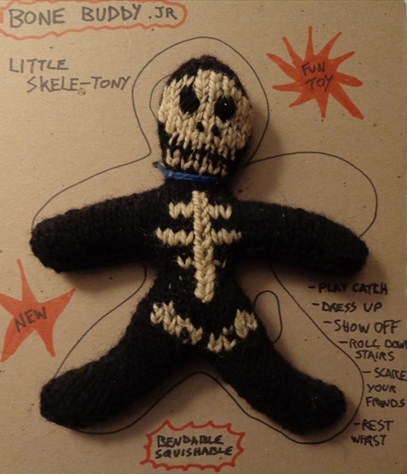
                                My back mascot - Bone Buddy  A.McKinnon

Friday, 4 January 2013

RA and Osteoporosis: "I Leave That To The Bone Docs"

The title is a quote from my rheumatologist when I asked him about the choice of medications for osteoporosis.  He wasn't ignoring the problem, just referring me on to another specialist for the osteoporosis, which is not part of his expertise.


I found this humerus

Here's the history: After 20 years with Rheumatoid Arthritis (RA) my GP sent me for a DEXA scan. It was used as the baseline and showed I was well below normal bone density. My GP doctor told me to take calcium supplements and we'd see what happened. Over the next three years even with calcium, vitamin D, and hormones it just kept dropping.  In that period I even  exercised!  When I went to the osteoporosis clinic they reviewed my diet for natural sources of calcium, kept me on the HRT, and upped the calcium and Vitamin D.


The picture is from a blog: http://www.kksphotos.com/blog/ which has a great series of posts on Bones and Hormones from an Osteoporosis Educator. You can see what bone density means by comparing the two views.
                                                                    
When I went back a year later my bone density had plummeted to the level of actual osteoporosis, not just osteopenia.  At that point they prescribed a bisphosphonate - Fosavance.  I took it weekly for the next four years and every year the density improved.

When they decided that the time had come to stop the prescription I protested because I was afraid that it would drop again.  The doctor said adamantly that they don't treat bone density now: They treat falls risk. One year and one scan after stopping the bone density drug, my density has gone up yet again and is a little better than normal for my age and better than the baseline.


                                       Don't take it from her. Smoking is bad for your bones.

That improved score leaves me wondering.  I have read that osteoporosis is systemic, so if the bone density goes up does that mean I no longer have that condition?  I will be looking for that answer.

It is also worth noting that during the last 5 years with the improvement I have been taking a biologic drug and also have stopped drinking soft drinks.  Maybe that also helped a little.

Later comment: 
What I did not even touch in this post was the anger I felt that I had not been informed by healthcare professionals during my first 20 years with RA was that on its own RA is a risk factor for osteoporosis. The basic advice should have been to take calcium and vitamin D and try to exercise even though fatigue and pain made it difficult. I know doctors are busy but this is something that should be covered in a rudimentary hand out for patients with musculoskeletal health problems.


Saturday, 29 December 2012

RA and the Bone Surprise - Osteoporosis

When I was diagnosed with RA I knew that it was possible to have destruction and damage to my joints.  And I could tell by looking at my hands and my feet, and by the way that they felt, exactly where the damage was likely to be.

                                                                      BrookburnPrimary.net

But the problems are always in what you don't know and so don't ask.

This is what I did not know: While my joints were being damaged I was also losing bone mass. "This loss of bone mineral density in rheumatoid arthritis occurs early in the disease and this is the time to start treating for osteoporosis risk by preventing bone loss".


So the RA treatment I was getting was aimed at putting out the house fire (inflammation) while there were termites in the beams (loss of bone mass).


That's my rheumatologist there in the front seat of the fire truck concentrating on putting out the house fire(inflammation).  None of my 3 rheumatologists ever mentioned osteoporosis as something to worry about.  I had 20 years of treatment with  never a word (that sunk in) about the dangers of osteoporosis,thinning bones and fragility fractures.


Once I found out that my inactivity and inflammation had actually made my bones hit the red line for osteoporosis my first reaction was anger.  Then I kicked myself for not using common sense and figuring this out.  Next I got a referral to the Osteoporosis Clinic at Women's College Hospital in Toronto.  They have an excellent multidisciplinary program where patients meet with a doctor, physiotherapist, dietician, pharmacist and an occupational therapist.  Armed with all of that information I was ready to be a late starter and work on my bones.

I started with simple muscle tightening which I describe in my blog post here.

Now I do a modified form of Pilates. It is customized to accommodate damage to my hands and feet and a fragile spine.  With osteoporosis you should avoid flexion (bending forward) as much as possible and do a lot of extension exercises.


I do it at home because I am afraid that I will be the Tin Man in the gym.  Exercising in a group may be more fun and if any readers in Toronto want to get together for Pilates they could join me, but the big plus to exercising at home is that all of the time you have available is used for exercise, not in getting from one place to another, including parking and changing.

Here is a link to my favorite osteoporosis site by Dr Susan Ott. You can calculate your own fracture risk using the calculator on the site. http://courses.washington.edu/bonephys/  She does a great job in keeping it updated and ad-free.

The next post will deal with what to do to improve your risks and why exercise is helpful.