Sunday, 29 June 2014

Taking control Part 5 - Dr Cindy Marek: Oral Health

Dr. Cindy Marek is a Dental Pharmacist at the University of Iowa in the Department of Oral Pathology, Radiology and Medicine. Her presentation was titled "Strategies for Oral Health and Comfort in Sjogren's Syndrome"


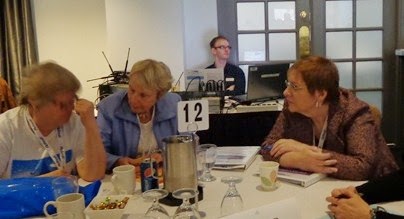
Dr Marek at the round table discussion

The practical advice she is able to give because of her experience as a clinical pharmacist specializing in dental pharmacotherapy can immediately be put to use. She explained to us how modification of lifestyle, medication administration and careful selection of over-the-counter products may lessen dry mouth symptoms and improve oral health and comfort.

She talked about how easy it is to overuse lip balm. She suggested that if it really worked well it would be impossible to sell as much - this design flaw is deliberate. The best product to use for dry lips is one that contains HPA modified lanolin. One product you can use is Lansinoh. It is sold as a product for use by nursing mothers so can be found at many drug stores as an over the counter purchase. 


Don't hang your lips out to dry

It is also a good idea to protect your lips in cold weather by using a scarf and also to make sure there is enough moisture in the air by using a cool mist humidifier. You need a sunscreen in your lip balm because you need to protect the thin and sensitive outer layer. It's a good idea to stock up in summer since it is a seasonal product.

There are over 500 medications that can affect oral dryness (xerogenic agents). These include antihistamines, antihypertensives, opiods, muscle relaxants and psychotropics such as antidepressants and antipsychotics. For the antihistamines she pointed out that products containing diphenhydramine (like Benedryl) are more drying than those which contain loratidine (like Claritin)

If you need to take a medication that has a drying effect sometimes taking a smaller dose, or perhaps a lower dose more frequently will help. Many healthcare providers are not aware of the incidence of dryness with certain drugs. Pharmacists are good resources for this information but of course you should consult your doctor about changes in medication dosages.

All stimulants are drying - this includes caffeine. Most of us are unaware of the amount of caffeine we consume. If you decide not to drink any more beverages with caffeine go slowly - caffeine withdrawal will occur if you stop suddenly.  Even gradually reducing the amount by 10% a week can help you.

I was surprised to learn that only added caffeine must be listed on labels in the US. If a product naturally contains caffeine the amount is not listed. Look for guarana, yerba mate, chocolate or coffee flavoured foods - they will contain caffeine. Even energy gummy bears have caffeine. 


From Vat19.com

Other things to avoid are alcohol-containing mouth rinses, acidic foods and beverages and toothpaste that contains SLS (sodium lauryl sulfate) which can cause tenderness and ulceration in the mouth.

According to a 2011 Cochrane review there is no strong evidence that any topical therapy is effective for relieving dry mouth. Oxygenated glycerol triester (OGT) spray is more effective than an electrolyte spray. 

In some studies chewing gum was the preferred product of patients. Chewing does stimulate saliva flow: the best gum choice is sugar free and contains xylitol or a xylitol/sorbitol mix. Cinnamon and strong flavours should be avoided

Another suggestion was MI Paste, especially at night, to give a good slick feeling in the mouth. 

Dr Marek also said "The burn is bad." If what you are eating or chewing gives you a burning sensation in your mouth, it's best that you avoid it.

Monday, 16 June 2014

Online vs In-Person Patient Support Services #HCSMCA Tweetchat

Natrice Rese (@natricer) and I (@anetto) have had various types of experiences with patient support services, both large and small. Here is an outline of the topics we will explore this week on #hcsmca, Wednesday, June 18 at 1:00pm during the weekly tweetchat.

There are patient organizations for almost every illness. Their purposes include promoting awareness and providing information about the disease. Many also provide support services and help patients and families connect with other people like them. Many patient organizations also advocate for improvements such as better treatment, access to medications and more research funding.

There are patient-led organizations, such as The Sjogren's Society of CanadaEmanuelSyndrome.org or FMDchat.org  and others that were founded by medical professionals, such as the Canadian Diabetes Association, the Canadian Cancer Society or The Arthritis Society as some examples.

A major benefit of this type of organization is that you can self-refer, that is, you don't need a doctor's referral to get the benefit of education and help from them. I have been a recipient of in-person services from The Arthritis SocietyMeeting others with the same issues as mine in self management courses has been valuable. The advice and help of physios and occupational therapists is also irreplaceable.

Later I discovered a self management course offered online which is based on research done at Stanford University. Many self management programs owe a debt to this research from the  80's. It is still going strong and people with chronic illness can enroll in it here Better Choices, Better Health.


In-Person Support services

One thing all of the charities have in common is a need for funding to carry on their good work. In times like this when money is scarce and the organizations have to make hard decisions how do they continue to meet the needs and demands of the patients they serve?

Increasingly patient organizations are augmenting their communication and support services with electronic solutions - eNewsletters, webinars, e-learning, video, online communities, chats and other social media platforms. In some cases, organizations have chosen to replace in-person services with online delivery. The internet offers great opportunity but there are limitations to online means of communication. Obviously, if money were no object, offering both online and in-person services would be the perfect solution.
Online support services

For rare diseases, online is often the only way to connect with others who have the same health issue, but organizations serving more common conditions may be neglecting some segments of their patient group by moving services to online only. Some patients and families with no computers or ability to use them. There are many people in this category including the poor, those with language difficulty or with low literacy. Some prefer not to use online services because of privacy concerns and/or a fear of social media.

On June 18th, #hcsmca will explore the complexities of choosing between online vs. in-person patient support services when organizations can't afford both.

  • T1: Is it ethical to opt for online only delivery of patient education and services?
  • T2a: What services are better delivered online and which in person and for whom?
  • T2b: Is online delivery of services actually cheaper?
  • T3: Share an example of quality and cost-effective online support systems for patients

Additional Reading

The impact of chronic disease self-management programs: healthcare savings through a community-based intervention.

Adaptation of the Chronic Disease Self-Management Program for Cancer Survivors: Feasibility, Acceptability, and Lessons for Implementation.

Saturday, 7 June 2014

Taking Control Part 4 - Sjogren's Conference - Dr. Rookaya Mather: Dry Eye

Dr Rookaya Mather is Associate Professor of Opthalmology at the Ivey Eye Institute at the University of Western Ontario and Department of Opthalmology and a researcher specializing in Cornea and External Eye Disease in London Ontario.

She chose Sjogren's Syndrome and Tear Film Dysfunction as her topic. Dr. Mather defined dry eye as a multifactorial disease of the tears and ocular surface that results in discomfort, visual disturbance and tear film instability with potential damage to the ocular surface. It is accompanied by increased osmolarity of the tear film and inflammation of the ocular surface. This is the definition of dry eye from the International Dry Eye Workshop (DEWS)

This can be very disruptive to your life. It has an effect on your quality of life that is similar to moderate angina. It's possible for dry eye to be caused by drugs or a serious lack of Omega-3 as well as by Sjogren's Syndrome.

Nitro for angina

In Sjogren's patients with severe dry eye researchers have seen on biopsy that 50% of the glandular cells are still present. This emphasizes the importance of immune factors in inducing glandular dysfunction. 

Another contributing cause for dry eye can be Meibomian Gland Dysfunction (MGD). With Sjogren's there is a decrease in expressibility that leaves the lipid layer deficient and lets tear evaporation increase. When this happens your tears become very concentrated. This promotes inflammation. For some people warm compresses and eyelid massage help with MGD.

You may also see redness on the eyelid margin. This is a sign of Ocular Rosacea. The inflammation on the ocular surface is thought to be mediated primarily by CD4 cells.

You need tear film on your cornea at all times for protection or your corneas may break down. When you use eye drops you should avoid drops containing preservatives.  BAK is the worst one and it is also found in glaucoma drops. Autologous serum tears are the closest to natural tears.


She's got Botticelli eyes

As your eyes become more dry, ocular findings worsen. There are some types of eye wear that help reduce the flow of air over the eye that preserve the tear film.  These include wraparound glasses and cycling shields, Panoptx, plano glasses or the scleral contact lens. You need to be especially careful to moisturize at night since tear production drops then.

Dr Mather ended with more good advice. Number one was "Be proactive, not reactive." Sticking to a daily care routine is essential. When you read close your eyes after each page for a few seconds more than a blink.

This is the comprehensive strategy to manage dry eye in 5 points:
1. Tear supplementation
2. Control of inflammation
3. Reduce evaporative loss
4. Support meibomian gland function
5. Prevent disease progression


Omega-3 capsules with fish pictures

Lifestyle factors can help. She suggested 2000mg of fish oil daily, use of lubricating eye drops, lid hygiene, warm compresses, possibly punctal plugs. Also consider flaxseed oil . Another idea that was new to me involved rolling a small bottle (like a pill bottle) full of warm water over the eye for a warm massage.

You can find more information about dry eye here at Dr R. Fox's site and more info on compresses for dry eye at this site which I found through dry.org. It also mentions eyelid massage.


Monday, 26 May 2014

Taking Control Part 3 - Sjogren's Conference Dr Ann Parke: Systemic Sjogren's Syndrome

Dr Parke has been a huge supporter of Sjogren's Canada almost from the beginning. Maybe it's due to some of her early training at McMaster University in Hamilton and the Canadian link. Now she is a leading practitioner and educator in this field and we were delighted to welcome her to the conference.  Here she is with Sjogren's Society of Canada President and Founder Lee Durdon.


Photo from Sjogren's Society of Canada. Dr Ann Parke on right, President Lee Durdon on left

Dr Parke began her talk by describing Sjogren's Syndrome as a lymphocyte aggressive disease, that preferentially attacks the exocrine glands, ie the glands that have ducts. She gave three other ways to describe it:
1. an "autoimmune exocrinopathy"
2. an "autoimmune epithelitis"
3. Lupus of the mucous membranes

I love to know how illness is described by doctors so that I am not taken unawares in a visit.

There are a number of criteria to be met to get a diagnosis of Sjogren's Syndrome. They include subjective complaints and objective tests of dryness, pathological changes and auto-antibody production.
Dr Parke described a four pronged approach to management of Sjogren's: 
1.  Manage the complications. 
2. Manage the disease
3. Monitor for serious complications
4. Education

As part of management good dental care is a key with frequent visits to the dentist, fluoride and anti-microbial therapy and the stimulation of secretions (saliva) with oral cholinergic agonists like pilocarpine (Salagen) or cevimiline (Evoxac).  This benefits patients by increasing saliva flow and reducing dental caries and oral candidiasis.  Speaking for myself it helps me with my voice and with swallowing. It's easier to talk and I don't choke as much as I did without it.


Salagen pills in natural habitat

Dr Parke says it's an exciting time in Sjogren's Syndrome, with new treatments in development.

Rituxan has been used since 1997 and has a good safety profile in treatment of primary Sjogren's. Orencia is being looked at as a possibility. Dr Parke uses anti-inflammatory agents like hydroxychloroquine, low dose prednisone, methotrexate and anti-BLYS. She said it takes two months to see results from plaquenil. 
Prednisone is good but it is necessary to watch out for side effects. 

One thing she stressed is that TNF inhibitors do not work.   

There was an open label study of Belimumab in SLE (Lupus) that covered 1746 patient years. At the end of the study 50% of the patients wanted to stay on it. That is a very impressive number. Over the long term patients continued to improve and their steroid use decreased.  Since Sjogren's is a cousin to lupus there is a lot of interest in a potential trial of belimumab in Sjogrens.

In the education area we need to raise awareness in patients, their families, health professionals and funding agencies. That's a big task. 

During the round table discussion I heard more facts from Dr. Parke. 

There is an association between PBC (primary biliary cirrhosis)
and Sjogren's Syndrome - some call it dry liver syndrome. The duct/vein/artery is the biliary triad seen in the liver with PBC. 


Happy Liver from PlushAnatomy on etsy.com

There was one funny moment when Dr. Parke answered a question about livedo reticularis and someone misheard her and started to talk about libido. (Quite a jump)  She said livedo can be associated with clotting disorders and anti-phospholipid syndrome, so one more thing to think about since it is also associated with Sjogren's syndrome.


Sunday, 18 May 2014

Taking Control Part 2 - 2014 Sjogren's Society of Canada Dr Mahvash Navazesh: Oral Manifestations

The second lecture of the day began with Dr. Mahvash Navazesh, a professor at the Ostrow School of Dentistry at the University of Southern California, introducing herself as the "Spit Queen". The title of her talk was Oral Manifestations of Sjogren's Syndrome  Most people take saliva for granted," she says. "It's one of the least-respected body fluids."


The level of dryness in the mouth predicts progression of the disease. Teeth show the effects of mineral loss long before the caries develop (2 to 2 1/2 years). To save teeth we need early detection. Saliva can now predict how susceptible we are to decay and which surfaces are at risk.

We learned that 1% of saliva is not water, but is composed of ions, proteins, small organic molecules, enzymes and microorganisms and by-products. Since dental caries is the most common infectious disease we really need the help of saliva to protect our teeth. It can provide buffers to neutralize plaque acids and to promote remineralization of teeth, as well as by cleansing the surfaces and by maintaining a balance between "good guys and bad guys" in the mouth.

By the time dryness is evident people with Sjogren's have already lost 50% of their salivary gland function. If the saliva loss is a result of medication use, once you stop using the medication function returns in two to three months. When the loss is from Sjogren's it takes constant care and lifestyle adjustment to deal with situations like waking up with your tongue stuck to the roof of your mouth or even taking care not to sample any dry food in a store because you might choke. 
Dr Mahvesh Navazesh
Normal oral care is not enough for us. We have to do more and here is a list of good practices from Dr Navazesh's slides:

Dietary counseling
Avoid alcohol, cariogenic snacks and soft drinks
Avoid dry, crisp, crunchy food and snacks
Meticulous oral home care
Daily oral hygiene, including oral prostheses
Avoid alcohol containing mouth rinses
Daily use of fluoride toothpaste and mouth rinse
Regular professional oral evaluation and care (frequency depends on severity and compliance)
Office application of fluoride varnish, gel or mouth rinse
Hydration/lubrication
Keeping lips and mouth lubricated
Saliva stimulation through xylitol gum, sugarless mints
Use of pilocarpine or evoxac to make the glands work harder

Dentists generally "drill, bill and fill" and sometimes I feel like my mouth will be a gold mine but even a great dentist can't guarantee their work when your oral environment is not normal. On the plus side Dr. Navazesh says that there is hope on the horizon, possibly through gene therapy.

Here are some articles that give more details of Dr Navazesh's work:
Salivary dysfunction associated with systemic diseases: systematic review and clinical management recommendations 


Spit Power

Here's the link to Part 1 of the coverage of the 2014 National Conference of the Sjogren's Society of Canada