Saturday, 16 March 2013

The Expert Patient

After a few years with a chronic illness we certainly become experienced, but that alone does not make us experts.  Achieving expert status takes work.


                                We Are Experienced

Does it really take 10,000 hours to become expert? In the case of illness endurance alone is not enough.  You've got to go out of your way to find out more. Educate yourself and you may become a knowledge expert, a support expert or maybe a connector or aggregator who puts information and people together for everyone's good.

I have found active Yahoo Groups in specialized areas. Sometimes the level of information available is due to one dedicated person.  Often it is core group which patiently covers the topics over and over as new people come along with an acute problem, use the advice and move on as their problems resolve. It's hard to keep a group going long term and many of them are gone when you go back a few years later.

I was lucky to find some real experts who saw me through two bouts of shingles.  
Illustration from Atlas of Human Anatomy, Frank Netter MD. Illustration showing how shingles spreads in bands (Dermatomes) on the body

When I went looking for a group with information about Fuchs Dystrophy I think I found the motherlode at a Yahoo group called fuchsfriends which is "a place of support and information for people with Fuchs' corneal endothelial dystrophy"


                                                 ehealthwall.com

These "patient experts" are so much help because they not only have a narrow focus on a specific disease but also they also have personal experience.  I am a member of another group where the moderator's signature is "Gina, Not an MD". Her advice is so good that the disclaimer is necessary. (Of course all such groups come with an additional disclaimer saying advice is not to be construed as medical advice)

Online support is a valuable commodity and I am lucky to be in a very long term supportive group at ra-factor.  Gilly, the group owner and "list mom", is one of the most empathic and consistent people I know.


                               Valuable commodity  dhotw.com

She said she does it because she can't imagine not doing it. Even on vacation she wonders how we all are doing.  She says "It's nice to talk to people, like a family" And after many years of conversation with these friends who "get it" because their problems have similarities to mine I would like to go visit them all in real life.

It would be quite a journey - to the UK, Australia, Canada and all over the US. Where but online would we ever have met and shared so much ?

And here we all are (approximately):

There are complaints about this map. More people wanted to be the cat than anything. Others said "Where are the dogs?" Our Texas member said we might as well just put a gun on Texas based on some current political moves.


                              A favourite "Welcome to the Group" gif


Wednesday, 13 March 2013

Progression of Damage and Why It matters

Damage to your joints sounds so academic and unlikely when you first get a diagnosis of inflammatory arthritis (or Rheumatoid Arthritis Disease). Even though joints are painful and swollen it's hard to believe that your bones will be affected.  I developed RA at 32 and took having good health for granted then.  There was no time to be sick with two boys 10 and 11 and a job.


                                       Anetto archive

You start off as normal healthy person and Rheumatoid Arthritis comes sneaking up on you gradually in most cases.  You start to notice pain and fatigue.  Your joints hurt and you feel so awful, and yet you still wonder  if you're sick or is it just life catching up with you? But now the effects are hitting you like a ton of bricks. My doctor thought I was dramatizing and hysterical so the process of finding the problem took longer.


                                www.cropthornehouse.co.uk

But finally you have a diagnosis and start on methotrexate, the "gold standard" drug. You have to wait to feel the effects and they creep up on the RAD just like it crept up on you.  Finally you start to feel the drug is working. The pain and fatigue ease up and you can function better bit by bit, even though nausea and gastro effects may make you feel like crap. (And this is a good result) 

(note: injecting MTX is easier on the stomach than pills)

And you are happy that your joints are not swollen and there is less pain and fatigue.  Your normal/old life is hard to remember but you feel better and that's some relief.  However from my reading and the evidence of my own joints after years on MTX, damage to your joints may still be occurring. 

If you were to look at X Rays it is easy to see the difference between a normal joint and one seriously affected by RAD


                                     www.paincaredirect.com

Normal joints have space between them and you can see 8 separate bones in the healthy wrist.

I was shocked to find out after years with RA and MTX and assorted other Dmards that MTX does not stop damage to bones from occurring.  Your symptoms may improve with that treatment but it is no guarantee that your bones are not being eroded and that your joint space is not narrowing.

For years I thought that I was on the best treatment and did not think I needed a biologic drug.  That was before I saw information about new clinical trials and read that with a biologic there is a lot less joint destruction.

As an example the Premier Trial concluded that   "ADA+MTX (adalimumab + methotrexate) inhibited both JE (joint erosions) and JSN (joint space narrowing) progression independently of disease activity. JSN played a more prominent role in patient-reported outcomes than JE. Preventing the onset or worsening of JSN probably represents a critical aspect of effective disease management of early rheumatoid arthritis patients"

And here "Early intervention with combination therapy also offered substantial protection from radiographic damage compared with methotrexate monotherapy." 


                                  MTX Right/Folic acid Left

Dr Haraoui says this in an editorial from Annals of the Rheumatic Diseases

"Indeed regardless of the therapy used, approximately 50% of patients will not show radiographic progression over 2–3 years; This percentage increases up to 75–85% of patients receiving combination therapy, and those who do progress, progress less than patients on methotrexate alone."

There are many reasons that I have a lot of damage to my joints. Some is due to late diagnosis of course, but 20 years on MTX, even with other associated Dmards, was not enough to stop the joint damage.  By the time I had a wrist fusion the Dr could not distinguish the eight separate  bones and said there was no cartilage at all in the joint.

When you end up with this much damage there are many things that are difficult or painful for you to do and some things are just not possible anymore. Damage leads to disability. "The association between joint damage and disability in rheumatoid arthritis (RA), especially in the later stages of disease, is a main reason why radiographic joint damage is a common and valid outcome measure in RA clinical trials"


                             Structural Damage www.ehow.com

Here is one of the main goals of rheumatology treatment:
"The primary goal of treating the patient with rheumatoid arthritis is to maximise long-term health-related quality of life through control of symptoms, prevention of structural damage, normalisation of function and social participation." 

The treatment is now much better and the levels of damage to joints have decreased over each decade. The level of disability is decreasing over time with good treatment.  That's the good news


Saturday, 9 March 2013

Sjogren's Helpers

Every chronic disease comes with its own shelf of products to make your life 'easier'.  With Sjogren's Syndrome you have many parts of the body with symptoms that you have to deal with.


                                     cgphoto.photoshelter.com

There are many strategies that you hear of to help your symptoms in one way of another, very little that helps overall.  I looked around my house and found many standbyes and possibilities.

Salagen (pilocarpine) would be the winner if there was one prescription drug I would not give up. When I don't take it my mouth and throat get unbearably dry and I cough and choke when I swallow. My voice even becomes faint.


You can have a mouthwash made with the active ingredient (pilocarpine) I found it very bitter.

There are also many artificial saliva products available like MoiStir for one. Biotene makes a special dry mouth tooth paste and mouth wash, as well as my stand-by product Oral Balance.


The dental hygienist I see suggested a little olive oil for mouth dryness and a support group member suggested oregano oil. The benefits of using MI Paste and a night guard can be found here.  As you can see Oral Balance and MI Paste get a lot of use in my house. 


I keep the tubes sitting around for a while in case I run out and need to try to get one last bit out of them. Oral Balance is a product I use every night before I go to bed. I hate to wake up and have a dry mouth. It's a gel you put between your teeth and gums before bed.


And this is a product used by singers, one of those tried and true ideas based on a natural product.


In the category of dry eyes some use a personal humidifier at their bedside.  I bought a pair of these goggles called Tranquil Eyes through the Sjogren's Society of Canada and so far used them only on a plane.


I hear that they are also great for sleeping. The spongy part that touches your eyelid can be moistened for extra sleeping comfort. 

Blepharitis is often part of the dry eye equation. I have tried these items to help.  The Blephagel was suggested by my opthalmologist.


And don't forget the nose. I have found the saline spray the most helpful item so far.  I have not wanted to use a neti pot or a nasal rinse but I would if things got worse.


When my nose gets so dry I can feel it in the sinuses and that's when I use saline spray. I find the NeilMed easiest to handle.  It probably works best if you use it every day but it's easy to get tired of working so hard to stay in the same place.  That's what happens when you treat the symptoms and not the underlying causes. A lot of work and no apparent progress, though not getting worse is what we all hope for.

This is far from a complete listing of products and is not meant to be a commercial for items. They were all here in my house even though I use some very infrequently.

For additional information there are tips at Sjogren's Society of Canada, and also at Dr Robert Fox's helpful and comprehensive site called dry .org. That was one of the first resources I used.

It's also a great benefit to attend the Annual Conference of the Sjogren's Society of Canada. The speakers are all at the top in their fields, and there is an hour set aside to give patients in the audience a chance to ask speakers and other volunteer health professionals questions of their own.


Wednesday, 6 March 2013

An Immune System Gone Wild - Sjogren's Society of Canada

Dr. Arthur Bookman agreed to let us use his inspired title for the 2012 Sjogren's Society of Canada National Conference. He had used it for a webinar in the past, which you can no longer see but you can look at the slides he used and learn more about Sjogren's. 

It's a shame that it's so tough to make our immune system change its ways once it goes astray.  I wish for a miracle food or great medications.


The Sjogren's Society of Canada by now has had ten conferences, which has been a benefit to patients in Canada.

The information below about the speakers is very limited and only reflects a fraction of what they said. This conference is always one of the most informative ones I attend and in many years medical professionals get CME credits for attending.

There were 7 speakers featured with Dr Bookman starting off by giving us an overview. He says that people who come to the Sjogren's Clinic he runs have usually seen 3 doctors over 2 1/2 years before they get a diagnosis. He described Sjogren's as difficult to treat.

Then we heard from Dr Rookaya Mather. She pointed out that dry eye actually causes functional disability because of the visual disturbance and discomfort of the eye.  The effect on the quality of your life is similar to that of having moderate angina and it is best to tackle it early.  She recommends 2000 to 3000 units of Omega 3 per day from fish or from flax as being helpful.


                                        Omega 3's   anetto

The next speaker was Dr Juan Yepes talking about dry mouth, which is one of the worst symptoms to deal with if you ask me. There's a helpful product in the US called Aquoral which he recommended as the #1 prescription product.  He also recommended xylitol because it changes the action of the bacteria in the mouth, and chlorhexidine mouthwash. He mentioned this article about a proposed electrostimulative device that could help in future.


                                   xylitol molecule  wikimedia.org

As usual one of the most keenly anticipated segments was the round table discussions where individual patients have a chance to ask some questions of their own.  There were 11 tables, each with a doctor or other health care professional who would answer any questions we had. Even when your own question is not being answered it is instructive to hear the responses.


After a very good lunch we heard from Dr. Ann Parke. Her talk was titled "Sjogren's Syndrome a Lymphocyte Aggressive Disease: From Dryness to Lymphoma."  We found that 50% or more of RA patients may have Sjogren's Syndrome. There is an increased risk of lymphoma but it occurs in under 10%, and is most commonly MALT .  She mentioned a new concept that says Sjogren's is "Systemic Lupus Erythematosus (SLE) of the mucous membranes".

Dr Kevin Fung talked about Ear, Nose & Throat Complications. He sees 80% cancer patients and 20% Sjogrens and diagnoses by ocular and oral signs as well as saliva, blood work and biopsy. As an ENT doctor he deals with salivary issues, nose and sinuses, ear, thyroid and throat, including swallowing and speaking. His expertise was greatly appreciated.


Oh for the good old days of drool dogforum.com


Dr Miriam Grushka is the first person I would go to see for burning mouth syndrome. The symptoms include not only the oral burning but also dryness, the feeling that something is stuck in your throat and changes in the way food tastes. Your oral tissue can appear normal even though you perceive it differently.

Dr Cindy Hutnik was the final speaker and her talk was titled Eye Lid Facts and Fiction! I found out that 50% of people with rosacea have blepharitis. It is also very common in Sjogren's and rheumatoid disease. The lacritin which renews the eye surface is missing in dry eye.  To prevent blepharitis you need regular eye checks and also eyelid hygiene. This includes warm compresses, lid massage and lid washing. There is strong evidence that Restasis restores health to tear glands. Another point made was that avoidance of BAK (benzylchromium chloride) is important.  This is a preservative found in some eye drops. Preservative free is the better choice for frequent users and sensitive eyes.


So that's a small view last year's conference. I'm looking forward to another invigorating conference this year. If you are interested in attending you can get further details on the website at http://www.sjogrenscanada.org/ and I will see you there.


Saturday, 2 March 2013

Wrist Fusion Surgery

My wrist has a lot of damage that occurred before I was diagnosed. A few years after diagnosis I saw a surgeon who would have been happy to do a number of procedures to make my hands look and function better but I could not believe that it was necessary then.

25 years later...

Recently I was worried that I might have a ruptured tendon so I saw an orthopedic surgeon.  His opinion was that I had to have my wrist fused before he would do any other hand surgery. He said a replacement wrist joint was not an option for me, given the spotty success rate.  Since I had only about 10 degrees of movement in my wrist it sounded as though I would not lose much flexibility and my hand would be in a more functional position.

This is one view of how it looked before the surgery:


You can see that my hand above has an ulnar deviation. The whole hand is no longer straight. More often in RA it is the fingers that sway to the side. This is the way it looks now, after surgery:


Much better than before. Very strange how you don't really notice as things change over the years.  Finger deformities always seemed more obvious than the orientation of my hand. 

My operation was 5 weeks ago.  It was done as day surgery and it took  2 1/2 hours to complete.  I had a nerve block that numbed my whole arm.  When I saw my arm raised in the air after the nerve block and just before the operation I thought it belonged to someone else.  

After the operation they put a cast on from below the knuckles to above the elbow. That left me able to bend my arm a little.  You can't tell that from the picture because the cast is wrapped in a tensor bandage.  There is an open gap down the whole cast to accommodate swelling.  That purple arrow on my shoulder marks the correct arm for the surgery.  There were more markings under the cast.


The nerve block was very effective and I have moderate regrets I did not stay  conscious through the operation to hear the surgeon talk his surgical assistant through the process. However my curiosity wilted once they started.  I have heard the noise level in the OR is high and I know surgeons use power tools in their work. Remembering the noises was not on my bucket list.


Now that my wrist is fused it is supposed to be a pain free joint and stronger than it was.  It's early to say how that will work out but my fingers still move well. They were very bruised and swollen but that's normal after surgery.  Anything the surgeon touches seems to bruise and swell more dramatically now than it did when I was younger.


I am told that the incision is healing well and it is meticulously stitched - it will probably not be very noticeable. In the following picture you can barely see it.

                                               4 1/2 weeks after surgery

                                             just after stitches and cast were removed


I was glad to see this blog before my surgery. Reading someone's actual story of the process is more illuminating than reading the technical sites like Wheeless. I had read enough that there were no surprises after the surgery.

All in all my hand looks better in profile and straight on. After the cast was removed my elbow range of motion was diminished but with rehab exercises from the Occupational Therapist (OT) I have regained all of the motion of my elbow.

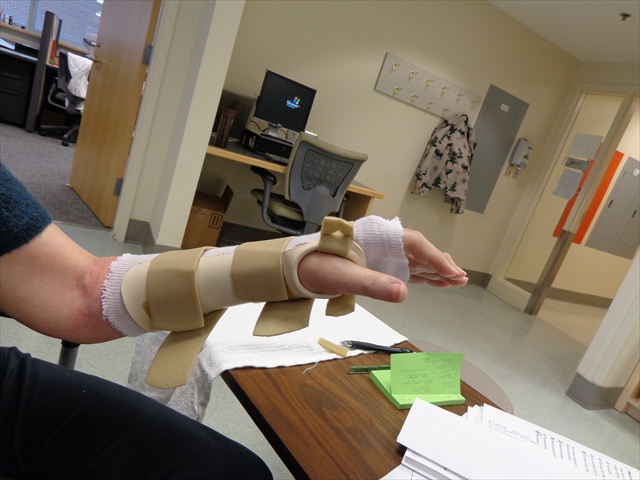
There is still some pain in my wrist as it heals, and I must wear a splint for the next month. The OT custom-makes them for each hand surgery patient.  The splint can be removed for washing and exercise.
                                     The Splint

I am doing a follow up post showing how it looks 4 months after, and also the X-rays of the hardware they actually use for the fusion. I can hardly believe what is under my skin.  You can see it here.