Saturday, 29 November 2014

Patient Preference: Not Always What It Seems

There have been suggestions that we look at the NHS in the United Kingdom for ideas that will improve health care in Canada. I've been told to look at The King's Fund as a source of good directions for goals to help in becoming an engaged patient and for ideas that we could use in North America. Even as I was hearing this I had a recollection of a research paper that I had read in the past and that did not impress me at all.

Here's the link. It's called "Patient Preferences Matter: Stop the Silent Misdiagnosis". I thought this sounded very positive. The patient voice would be heard and their choices would be respected.

But after I read the paper I felt uneasy and unconvinced that this whole plan would be good for patients. The example used to demonstrate the point was 'Susan'. She's 78, has a family history of breast cancer and a heart condition. After a mastectomy which showed clear evidence of breast cancer she talks to a friend who did not have surgery. She elected to slow the cancer with hormones. Susan is sad, and had she but known of the 'no treatment' option would have chosen it. This is called 'preference misdiagnosis' and of course no one knows how prevalent it is because it would be hard to measure.

breast cancer from cancer.gov

The suggestion in the paper is that the doctors of the NHS should be better informed about patients preferences in a general way through surveys and should  present all of the options.

The power that doctors have is very subtle. If my Dr. recommended treatment vs. no treatment and gave me the odds that would inform my choice I would  listen carefully. But the doctor has power in the presentation. We pick up cues in person to person exchanges. The suggestion of no treatment can easily be taken as a recommendation, and we can't all ask our doctors "What would you suggest for your mother?"

It's easy for the patient to tell what response is most desired and to be influenced by the choices the doctor presents. The aim is "Giving the patients what they would want if they were fully informed" But the underlying idea that this is an opportunity for the NHS to save billions of pounds seems as though it should be out of place in a discussion about patient preference.


Julie's opinion:
I have read this ridiculous article before and wondered what word games they were playing.  It sounded to me like they were encouraging people Not to seek professional healthcare and that the patient's "personal preference" should be for the good of the general economy - not the patient.  The conclusions are ridiculous in my opinion.

Gail's opinion

"I really think it’s vitally important that doctors do give us all the information so that we can be involved in the treatment choices. I would never, for example, blindly let a GP/Consultant prescribe me a course of treatment without at least doing my own research and knowing all the ins and outs first. I think part of this is about doctors realizing that our say in our treatment is vitally important, and ensuring we have all the medical knowledge we need to understand why a treatment might be the best for us, not just to be told that they are going to do this and that’s all there is to it.
We need all the options, not just the cheapest or easiest for them to accomplish."

The final point the article made was about the pluses of  getting patients involved, particularly the one that if patients knew all the choices they would be less inclined to have aggressive treatment and the NHS in the UK would save a bundle of money.

They imagine lots of people in their 70s and 80s saying "No surgery, radiation, chemo etc for me. I'll likely die of something else first""

My friend's mom is an equivocal example: For her it worked fine - she is a notable exception. Breast cancer at 83. Dr did lumpectomy - told daughter it was malignant but in view of her age he would not suggest radiation or chemo. He told his patient (her mom) they got it all. The Mom thought she ducked it and did not believe it when her daughter said it was malignant.


Now, 20 years later, she is 103 and still lives on her own. Lucky it was a very slow growing cancer and the lie to the patient had no ill effects.

Arthritis Affects More Than Your Body

In the post about "Changing Shoes" Dr. Backman showed how that image came to symbolize what we've lost with inflammatory arthritis.

That led me to think of writing a post about the psychosocial aspects of living with Rheumatoid Arthritis, only to realize that this is a topic for a book, not a blog post. Still, not starting at all is accepting defeat too soon. 

Here's a relevant paper that I found among the first results of a search - Arthritis and Pain. Psychosocial aspects in the management of arthritis pain. It's not new, but when was the last time you saw anything happen fast in arthritis, with the exception of flares? The study is a perfect follow up to the shoes metaphor since Dr. Backman wrote this paper too.

To start with a definition and a direct quote from the paper:
"psychosocial factors refer to two dimensions of experience: the psychological (cognitive, affective) and social (interacting with others, engaging in life activities)".

The impacts that arthritis has can be seen in all parts of our lives, but pain is a huge topic that we are not able to ignore. It can result in what used to be small tasks, like getting dressed or washing your hair, becoming more difficult. Many activities start to take more thought and effort. 

Pain can also be difficult to predict or explain when others can't see it. You can look fine but it gets more difficult to make plans and commitments. It takes a toll on your self esteem too when pain is physically and emotionally exhausting and overwhelming.

Arthritis has impacts on our families and on our communities too. It was a huge change to my family when I was suddenly too tired and sick to be consistent in what I was able to do as a mom. I know it had an effect on my children.

With my husband, I worry. I saw the toll it took on my Dad and my father in law when they had to assume the role of caregiver when both my mother in law and my own Mom had health issues late in life.

The bulk of the cleaning and shopping fall to him now, and when I was too tired to socialize after working a full week, he also missed many get-togethers.

It's a balancing act

In my work life the stress was more a pressure to achieve results that it was physical, but that was in the job I found after it became evident that working full time in a bank took too much physical effort.

What many people find is that their whole lives change and dealing with illness and changes at the same time is very challenging.  I'll let Julie talk about some of the changes she has seen in her life.


"I think the biggest problem that I have socially is not being able to plan much in advance.  I don't know how I am going to feel on any certain day.  Sometimes, I will accept invitations with the understanding that I might not be able to make it depending on how good or bad I feel that day.
 
Clothing and shoes is also another consideration.  Trying to find something that looks kind of dressy and nice while wearing really clunky, orthopedic type shoes is a problem.
 
I try to never plan anything for the morning before 10:00 a.m.  It takes me that long to eat breakfast, take my medications, get dressed, etc.  I have to plan to go slow in the mornings - so no early morning socializing for me anymore.
 
When younger, I used to be much more sociable, but I have to limit the socializing  now.
 
I think it is all about knowing your limitations and accepting them".

Julie's outdoor cat, Grover

Friday, 28 November 2014

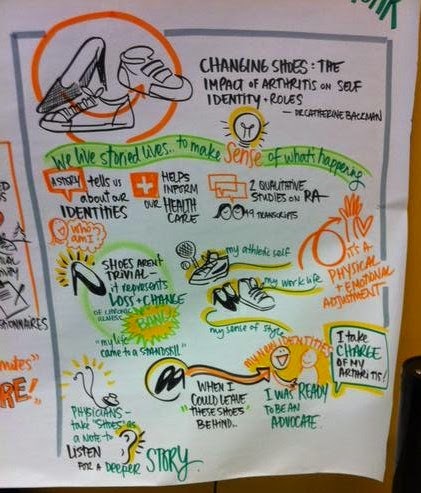
Changing Shoes: The Impact of Arthritis on Self Identity and Roles

Dr. Catharine Backman is a Professor and Head of Department of Occupational Science and Occupational Therapy at the University of British Columbia and a research scientist at the Arthritis Research Centre. She got the biggest response on the #eROAR twitter stream talking about her research on ways arthritis can change your self-identity.

Sam Bradd's graphic depiction of Dr. Backman's talk

Dr. Backman has done two studies about self identity and role changes, and said the most powerful example of the loss of self was the shoe metaphor. "We lead storied lives and the narratives and metaphors we use help us and others to make sense of our experiences."

"Changing shoes" represents not only a physical adjustment to accommodate pain, but also part of an internal process of reshaping identity. It is a very constant symbol of loss of professional self, stylish self, working self. Women eventually "gave up" their shoes and found a new sense of self or an identity no longer represented by the old shoes"

One of the contributors said that if you were more sedate and always wore granny shoes this issue may not turn your life around, but I don't know anyone under 50 who feels like that. When I went to a shoe store looking for style and comfort at the onset of arthritis, and they showed me the granny shoes I almost walked out (almost cried is actually more accurate). I ended up with green leather lace up boots and that helped.


These shoes are not cool. Will never buy shoes like these

Part of your life is gone, it's an internal process of reshaping identity symbolized by shoes.

.@cath_back at : how can the experience of living with change how people view themselves?

Important to share stories of how people came to transition to new identity with  @arthritis_UBC

"Flat shoes meant pants and never wearing dresses...my life became different...after a few years RA just wasn't getting better"

Experiencing - a transition story: Giving up steel-toed boots = giving up the job. Flat shoes = never wearing dresses   ARC

Very true! @anetto: Shoes is a transition story, and it's not a transition people want.

For women: the type of shoe worn mirrors the life being lived> high powered work/ special occasions all accompanied by elegant shoes.

Metaphor of changing shoes represents many losses occurring as part of living with  

@Arthritis_UBC @Bonnycastle @nxtstop1 @cath_back Finding like minded people a big help. They're in mourning too for cool shoes

Past blog post of my own about shoes and life changes  http://yourgoldwatch.blogspot.ca/2013/01/cry-me-river-of-shoes.html 

@Bonnycastle @nxtstop1 huge adjustments to 'who I am' - @cath_back suggests finding like-minded people via online groups/blogs could help

You all just gave me my next blog post idea. I have so many pretty shoes mourning in my closet! Along with outfits. My closet cries! @RareCandace

@Bonnycastle @Arthritis_UBC  Oh how wonderful ~ life : turning lemons into lemonade

MT @sarahlance: @nxtstop1 @maryadevera I have arthritis & plan 2 hike again. worry re perception we get as person w/RA,stereotyped...

Reading your stories makes me glad I can still look like I'm in college, so flip flops, flats, boat shoes. I'm very "Miami"


@AfternoonNapper: MT Oh, ladies... this has been a HUGE thing for me. Would love to discuss. In a meeting right now though.

I spy a discussion about shoes. My inner fashion diva gushes. I had to give up heels after DX. Too dangerous/painful! @RareCandace

Putting old shoes away/giving to charity carries great meaning to 'Who I am' - transitioning to new identity with

Not always a bad news story, people find new shoes, new identity, new role, including advocate  @maryadevera

Shoes are part of our foundation. Changing is difficult-who am I now?.

Dr Backman's research about Changing Shoes really resonated. Felt so much "less" at professional meetings in ugly shoes

Changing shoes...represent profound loss of sense of self in rheumatoid arthritis

Help seeking process. It's so hard to have to ask for help. It is part of identity change, along with shoes me

@nxtstop1 Yes, agree. My shoes are very ugly and it was (and still is) an issue though less now

Issue of shoes and arthritis: uh oh.... my issue :( have to wear low heel shoes,try to make stylish (gone are the stiletto days.. lol)   @nxtstop1

What do shoes and family dinners have in common? Metaphors in rheumatoid arthritis patient experiences.

Implications of the research:
from Dr Backman's slide.
"Appreciating how seemingly small changes carry great meaning with regard to one's identity may foster more effective patient-provider communication and client centered practice.

Yes, shoes are a big deal to many! but more importantly, they represent some poignant losses that accompany chronic illness".

I can see this happening myself in some relatives. My mother in law just could not give up her impractical shoes after she became ill. I've had a long time to change my own life and adjust to what I still call ugly shoes. It can't be done overnight, and yet we were all very impatient when she stubbornly refused to change. Not many women want to wear "sensible shoes" and, as Preston pointed out later in the day, neither do men.

Thursday, 27 November 2014

Coping Through Adapting: Not Quite the Same as Doing Well

A few years ago my rheumatologist used a computerized patient reporting system on a trial basis. Patients were asked to fill in a detailed questionnaire at home the day before their appointment. I'm sure it was useful for the doctor to see a graph of people's progress over a period of years. I was very enthusiastic to see my chart take shape as time went on and to be able to track the changes in my reported health. The link to the chart is similar to the one I used but not the same.

It took a while for me to notice how little change there was in some areas. With rheumatoid arthritis (RA) I could see changes in pain, sore and swollen joints, and activity levels of  RA. What didn't change was the global assessment and I came to realize that it would take an amazingly good or a shatteringly bad result to change that marker at all.


Known as a homunculus. RA version. Hands and feet exaggerated because of numbers of joints affected

The other area that did not seem sensitive was the health related quality of life (QOL or HRQOL). Over my whole time in this reporting system there was no significant change. Minor variations may have been connected with how literally I read the questions.

There were 25 statements to determine QOL which were rated on this scale:
Sample question. I can do chores such as vacuuming and yardwork...
Without any difficulty
With some difficulty
With much difficulty
Unable to do
Not Applicable

There are many things that you can do more easily by adapting your activities, products or the methods that you use to do things.

Some examples of this:
Opening car doors - Just shop for a car that has doors you can open.
Turning faucets off and on - Buy a lever-style tap
Cut your meat - Use a sharp or right angled knife
Lift a full glass or cup to your mouth - get lightweight or plastic glasses and cups
Open a new milk carton - Stop buying milk in cartons
Dress yourself including laces and buttons - Fewer buttons, ditch the Spanx, stop wearing tight pants where you have to force the zipper up and the button fights you, try velcro-closing shoes.

I'm sure you see where this is going. By making a myriad of changes in your life and habits, it looks as though you are maintaining you QOL. In a sense you are maintaining it because change is not the same as loss, but these changes make you feel that control of your life is going to the disease. None of the lifestyle alterations feel positive when you have no choice but to adapt.


Using a working splint helps me to cope with typing for a long time

So on the chart your condition looks stable, but in truth you are changing your habits in so many ways and your life is so affected by RA that you barely recognize it anymore. I say the measurement process is flawed.

Another item missing from this system was a measure of fatigue, which is very common in autoimmune diseases. It makes you wonder about the extent of patient input into these patient reported outcomes. Who is better than a patient to describe the outcomes and issues they deal with daily?

One article I found very interesting was titled Patient participation in psoriasis and psoriatic arthritis outcome research
by Maarten de Wit et al. Prior to the 2013 GRAPPA (Group for Research and Assessment of Psoriasis and Psoriatic Arthritis) annual meeting a literature review was done to confirm levels of patient involvement in previous outcome level development. They found 63 articles related to 26 outcome measures and only one described any patient involvement in determining outcome measures. This 2013 meeting was the first time there was an official patient presence at the meeting and it was described as "an important first step into incorporating their voice into GRAPPA's research agenda".

Amazing what literature reviews can tell you. I'll be looking for more, since it is hard to believe that psoriatic arthritis is the only disease area where the patient voice is missing in something as basic as outcome measures.

There's another post on this topic Dropping the Ball on Patient Outcomes?

Wednesday, 26 November 2014

Patient Safety in Hospitals. Could Patients Help?

When I returned from the Medicine X Conference at Stanford I felt empowered as a patient. Meeting so many people with healthcare ideals that were similar to mine made me feel as though anything was possible. Once I got back I saw an invitation for patients to attend this year's Patient Experience Conference. That was one in the "win" column - last year in social media there were complaints about the same conference for having no patients in the room. This year the policy changed, in part due to sponsors I'm told.

Yet in hospitals as a patient I often don't feel like the advocate I am. I don't feel empowered - I do what I'm told to do. I would like to see a forum or some route for input into the Safety and Infection Control practices, but though I read the newsletter, newspapers, emails and even the signs posted looking for volunteers for mental health, depression, bone health, migraines etc, I see no way to join any discussion of safety and infection control in a particular institution.


As an example of an issue, the idea of walking barefoot on a hospital floor would not seem healthy to many people and yet I am asked to do that regularly. It's an ingrained habit not to rock the boat. Friends in my online group relate similar experiences, like Julie's at her hospital, when the CT tech wanted her to lie down on a sheet that did not look clean. She felt like taking a dirty sheet in to them with a footprint on it and then a clean sheet to show. the difference.

I would argue that no one is perfect, and that try as they do, the infection control committees could use input from patients who sit there sometimes for hours on end observing what is going on around them and worrying.

There are many more examples now of hospitals listening to patients and those are steps in the right direction but I would like to see them all on similar paths.